

What is Expected Value?
Expected value (EV) is a fundamental concept used in probability and statistics to determine the average outcome of a random event over the long run. It is especially crucial in various forms of gambling, including sports betting. In simple terms, expected value helps you understand what you can expect to win or lose on average from a bet if the same bet were to be repeated many times.
To calculate the expected value, you multiply the probability of each possible outcome by the respective amount you would win or lose in that outcome and then sum those results. Here’s a generic formula:
\[ \text{Expected Value (EV)} = (\text{Probability of Winning}) \times (\text{Amount Won per Bet}) + (\text{Probability of Losing}) \times (\text{Amount Lost per Bet}) \]
By calculating the EV, bettors can determine if a particular bet offers a favorable return over time. A positive EV indicates a potentially profitable bet, while a negative EV suggests a losing proposition in the long term.
Calculating Expected Value: A Practical Example
Let’s consider a practical example of calculating EV in the context of a sports betting scenario. Imagine there is an upcoming basketball game between Team A and Team B. You were considering placing a bet on Team A https://gg-bet-ar.com/en/ winning the game. Odds given by your betting site state that Team A has an odds of 3.0 (or 2/1 in fractional terms) to win.
1. Determine the Implied Probability: The odds of 3.0 suggest that the implied probability, which is the probability that the betting market assigns to this event happening, is calculated by the reciprocal of the odds. In this case, \( \frac{1}{3.0} \approx 0.333 \), or 33.3%. This means that according to the betting site, Team A has a 33.3% chance of winning.
2. Assess Your Probability Estimate: Suppose through your analysis, you estimate that Team A’s real chance of winning is around 40%. This is where your knowledge or inside information plays a pivotal role in identifying value bets.
3. Calculate Expected Value: Now, assuming you plan to bet $100 on Team A. The calculations would be:
– If Team A wins:
– Your winnings would be $200 (you get $300 back, including your $100 stake).
– The probability of winning, as per your assessment, is 40% or 0.40.
– If Team A loses:
– You lose your $100 stake.
– The probability of losing is 60% or 0.60 (100% – 40%).
Using the formula:
\[ \text{EV} = (0.40 \times \$200) + (0.60 \times \-$100) \]
\[ \text{EV} = \$80 – \$60 = \$20 \]
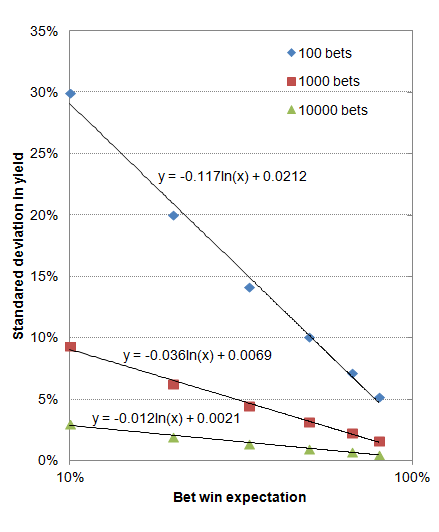
The positive EV of $20 means that for every $100 bet on Team A under these conditions, you expect to make an average profit of $20 over the long run.
Significance of EV in Betting Strategy
The real value of understanding and using expected value is not in predicting the outcome of a single bet, but in consistently making betting decisions that have a positive EV. Here’s how it significantly impacts your betting strategy:
1. Risk Assessment: Knowing the expected value of a bet can help you assess the risk versus reward. Bets with higher positive EV are generally considered less risky in terms of long-term profitability.
2. Bankroll Management: By focusing on EV-positive bets, you can manage your bankroll more effectively, ensuring sustenance and growth over time rather than sporadic highs and lows.
3. Identifying Overvalued and Undervalued Bets: EV calculation helps to identify when teams or outcomes are undervalued (higher EV) or overvalued (negative EV) by the market. This identification enables bettors to exploit discrepancies in what the market thinks will happen versus their assessments.
Applying EV Beyond Simple Bets
Expected value is not just limited to straight bets on win/loss outcomes. It can also be applied to more complex betting types such as parlays, props, and futures. The principle remains the same: calculate the average outcome based on your estimated probabilities versus the implied probabilities reflected by the odds.
When considering a parlay, for example, the overall EV is determined by the product of the EVs of each bet involved. This can lead to a dramatically different risk profile, often resulting in higher variance – greater risk and reward.
Challenges in Utilizing EV Effectively
While the concept of expected value is mathematically straightforward, its application can be complicated by several factors:
1. Estimation of Probabilities: The accuracy of your probability estimates is crucial. Inaccurate assessments lead to faulty EV calculations and potentially poor betting decisions.
2. Changing Odds: Sports betting odds can change as the game approaches, influenced by market actions, news updates like injuries, and other factors. This volatility means that the EV can change, requiring frequent recalculations.
3. Emotional Factors: Bettors may struggle to maintain an objective stance. Personal biases towards favorite teams or players can skew probability estimates and impact betting decisions.
In conclusion, while expected value is a powerful tool in sports betting, it requires careful application and constant refinement based on incoming information and changing market conditions. By understanding and properly applying the principles of expected value, bettors can significantly enhance their strategic approach and improve their overall profitability in sports betting.